
Summarise the information by selecting and reporting the main features, and make comparisons where relevant.
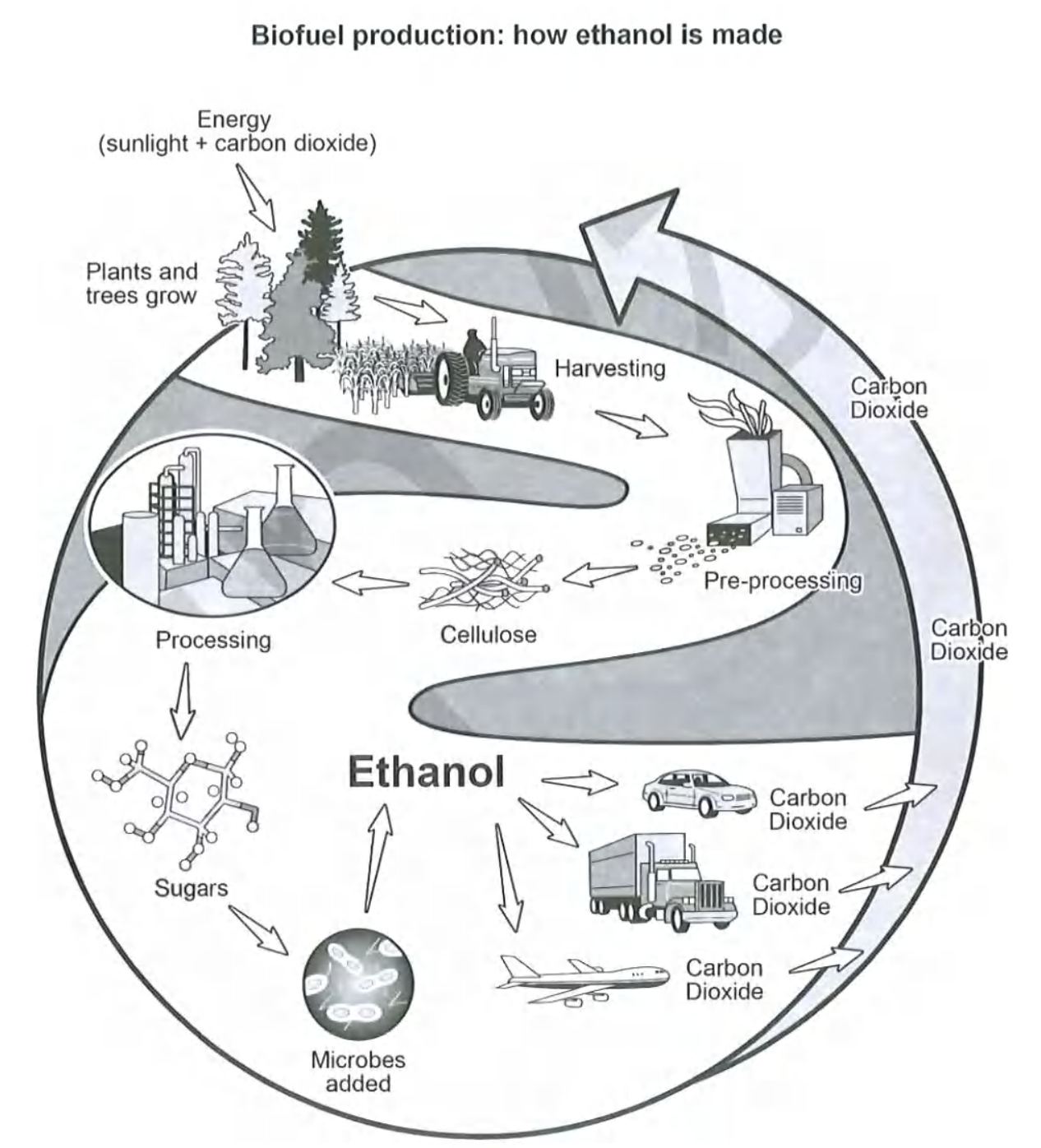
The diagram illustrates the process involved in producing ethanol, a type of biofuel. Overall, the production can be categorised into three key stages: harvesting, pre-processing and processing, forming a cyclical system.
In the initial stage, plants and trees absorb sunlight and carbon dioxide to generate the energy required for growth. Once fully grown, they are harvested and enter the pre-processing phase. During this stage, the plant material is fed into a cutting machine, where it is reduced to smaller fragments and converted into cellulose.
The final stage involves processing the cellulose into usable fuel. First, it undergoes chemical treatment to break it down into sugars. Microbes are then added to ferment these sugars, producing ethanol. The finished biofuel is subsequently used to power vehicles such as cars, trucks and aircraft. Notably, the combustion of ethanol releases carbon dioxide, which is reabsorbed by plants, thereby completing a sustainable carbon cycle.